Artificial Intelligence is rapidly evolving from simple single-agent chatbots to complex multi-agent systems that can reason, plan, and collaborate. For business leaders and technology teams, the key question is not just what AI can do, but what architecture will best support scalability, reliability, and ROI.

Artificial Intelligence is rapidly evolving from simple single-agent chatbots to complex multi-agent systems that can reason, plan, and collaborate. For business leaders and technology teams, the key question is not just what AI can do, but what architecture will best support scalability, reliability, and ROI.
At PerfectKode Software Technologies, we’ve seen first-hand how architecture choices shape success. Drawing on decades of collective experience in system programming and enterprise application development, our team helps organizations navigate the trade-offs between monolithic, modular, and multi-agent designs.
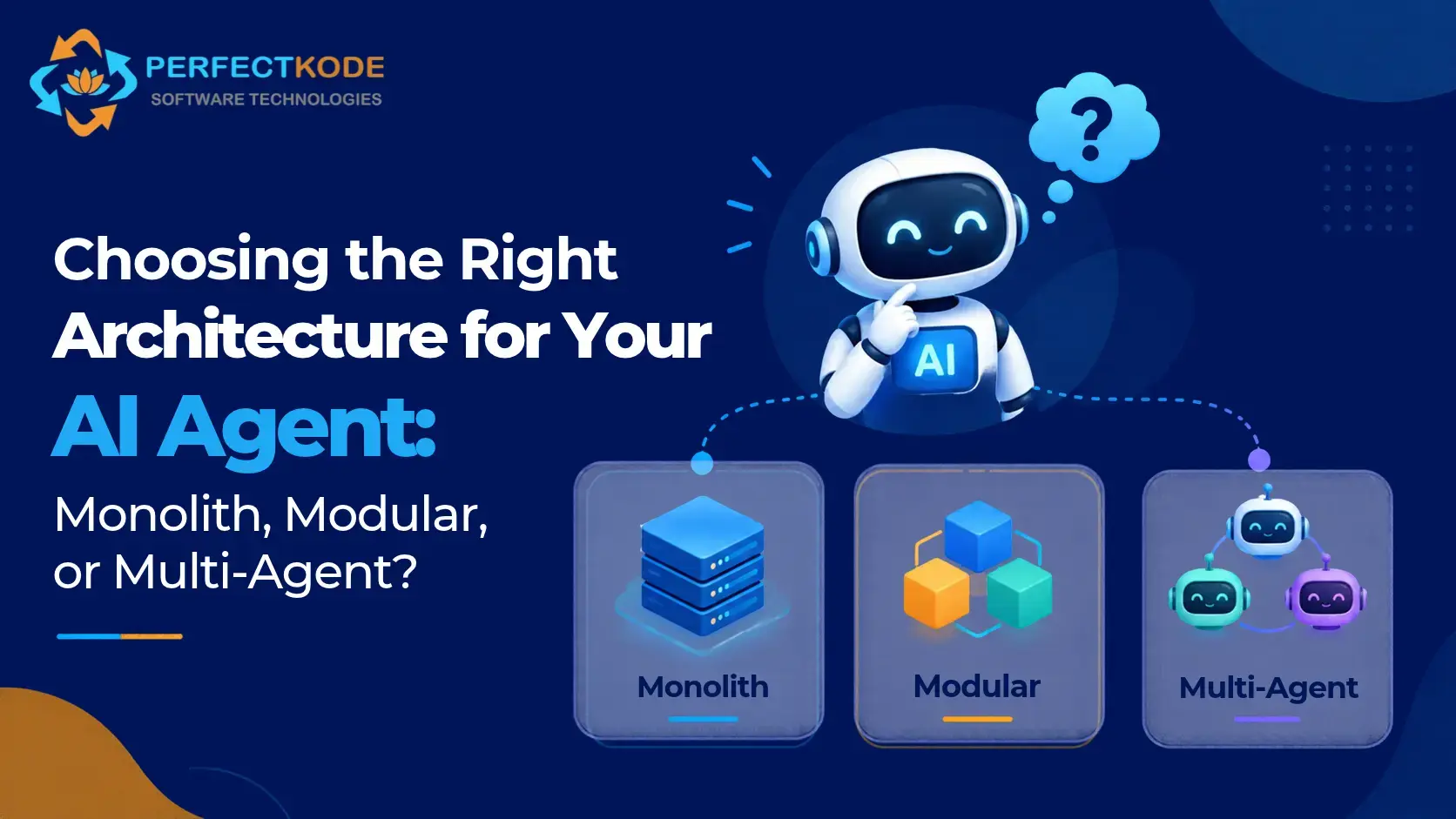
Monolithic (Single-Agent) Systems
- What it is: A single, general-purpose agent handles all tasks.
- When it works best: Simple workflows, controlled environments, early MVPs.
- Advantages: Lower setup cost, simpler to deploy.
- Limitations: Becomes brittle and harder to scale when tasks or data pipelines grow in complexity.
Modular (Single Agent + Plugins/Tools)
- What it is: A core agent enhanced with specialized tools or APIs.
- When it works best: Businesses that need one central “brain” but with flexibility to integrate external systems (CRM, ERP, HRM, etc.).
- Advantages: Balances simplicity with adaptability.
- Limitations: Still a single point of failure; advanced workflows may need orchestration.
Multi-Agent (Orchestrated Micro-Agents)
- What it is: Multiple specialized agents (research, planning, execution, monitoring) working under an orchestrator.
- When it works best: Complex domains (healthcare, finance, supply chain, HR tech) where tasks must be distributed and validated.
- Advantages: Scalability, resilience, specialization.
- Limitations: More complex to design and govern; requires robust coordination frameworks.
Emerging Frameworks for AI Agents
To implement these systems effectively, several open frameworks are shaping the future:
- AutoGen – Simplifies building conversational multi-agent systems.
- CrewAI – Focused on role-based, collaborative AI agents.
- LangGraph – Graph-based orchestration of agent workflows.
- Agentic – Practical tools for real-world multi-agent coordination.
At https://www.perfectkode.com, we evaluate these frameworks against business requirements to design architectures that are both future-ready and ROI-driven.
Final Thoughts
Choosing the right AI agent architecture isn’t just a technical decision—it’s a strategic business choice. Monolithic designs may be enough for an MVP, but modular or multi-agent systems unlock long-term scalability and adaptability.
How is your organization approaching AI agent adoption? We’d love to hear your perspective in the comments—or connect with our team at PerfectKode Software Technologies to explore how the right architecture can accelerate your business outcomes.
#PerfectKode #AIArchitecture #AIAgents #MultiAgentSystems #GenerativeAI #TechInnovation